Card games remain popular because one deck can support many experiences. Some take minutes to learn. Others require teamwork, memory, probability, and long practice. Indian players can choose local favourites, international strategy games, family formats, and solo options.
Interest in poker live also shows how broad the category has become. A player may sit at a physical table, use an app, or watch a tournament broadcast. The rules may be similar, but the pace and social experience differ.
This guide compares popular card games by difficulty, group size, length, and main skill.
What Makes a Card Game Popular?
A popular card game usually combines simple equipment with a clear goal. Many titles need only a standard 52-card deck.
Good games also create repeated decisions through drawing, discarding, bidding, bluffing, or forming combinations.
Skill, Chance and Social Interaction
Most card games combine luck and decision-making. The deal is outside the player’s control, but later choices still matter.
Simple games are easier to teach but may offer less depth. Complex games stay interesting longer and require more learning.
No strategy guarantees victory when random dealing is involved. Strong decisions help, but a weaker hand may still win.
Main Types of Card Games
Card games are easier to compare when grouped by their main objective:
- Matching games ask players to collect cards of the same rank.
- Combination games focus on sets, runs, or ranked hands.
- Trick-taking games reward the strongest eligible card in each trick.
- Shedding games require players to empty their hands first.
- Comparing games determine the winner by hand strength.
Some titles fit several categories. Indian Rummy uses matching, sequencing, drawing, and discarding. Bridge combines tricks with partnership bidding.
Matching and Combination Games
Rummy players build sequences and sets while improving their hands through draws and discards. Go Fish uses simpler matching and asks players to collect groups of equal ranks.
Trick-Taking Games
In a trick-taking game, each player contributes one card. Bridge adds bidding and partnerships. Hearts focuses on avoiding penalties, while Spades uses a permanent trump suit.
Comparing and Shedding Games
Poker and Teen Patti compare ranked hands. Bluff and Uno are shedding games where the goal is to remove all cards. Uno uses a special coloured deck.
Popular Card Games in India
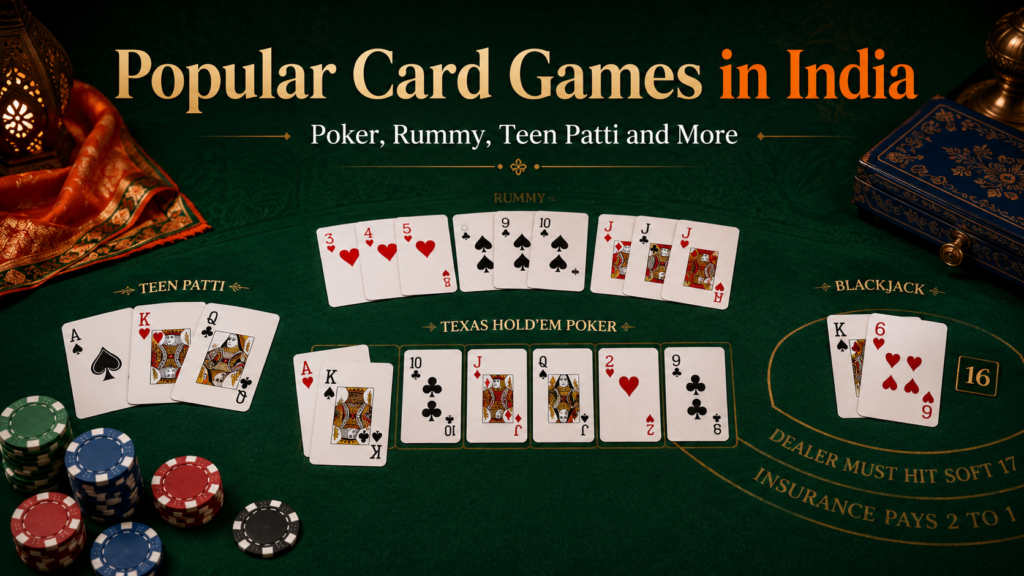
India has a strong card-playing culture with social, family, and competitive formats. Teen Patti and Indian Rummy are especially familiar, while Texas Hold’em introduces international poker rules.
Teen Patti
Teen Patti usually gives each player three cards. Hands are compared through rankings such as trails, pure sequences, sequences, colours, pairs, and high cards.
Its appeal comes from short rounds and social interaction. Bluffing matters, but the dealt cards still decide hand strength. It can be played with points or valueless chips.
Indian Rummy
Indian Rummy focuses on arranging cards into valid sequences and sets. Players normally draw one card and discard one card during each turn.
A pure sequence uses consecutive cards of the same suit without a joker. Rummy rewards planning and organisation but takes longer to learn than Teen Patti.
Texas Hold’em Poker
Texas Hold’em gives each player two private cards. Five community cards are then revealed in stages. Each player forms the best five-card hand from the seven available cards.
Decisions depend on hand strength, position, community cards, and other players’ actions. Good play cannot guarantee a favourable final card.
Expert Tip: Learn the hand rankings before studying advanced tactics. Most beginner mistakes come from misreading combinations rather than choosing the wrong strategy.
Popular International Strategy Card Games
Some games offer deeper planning and suit players who enjoy learning systems.
Bridge
Bridge is played by four people in two partnerships. Bidding determines the contract and often the trump suit before trick play begins.
It offers exceptional depth, but its scoring and conventions create a high learning barrier.
Hearts
Hearts asks players to avoid penalty cards, especially the queen of spades. It rewards memory and timing but is easier to learn than Bridge.
Spades
Spades is commonly played by four people in partnerships. Players bid expected tricks, while spades remain trump. Success depends on accuracy and teamwork.
Simple Card Games for Beginners and Families
A beginner game should have a clear goal, short turns, and limited scoring. Good options include:
- Go Fish for ranks and matching.
- Bluff for observation and simple deception.
- Uno for colours, numbers, and action cards.
- Old Maid for forming pairs.
- Snap for fast recognition.
Go Fish
Players ask for a specific rank and collect matching groups. The game develops memory and suits mixed-age groups.
Bluff
Players place cards face down and announce a rank. Others may accept or challenge the claim. Agree on penalties before starting.
Uno
Uno asks players to match the current card by colour, number, or symbol. Action cards can reverse play, skip a turn, or make another player draw.
Card Games for One or Two Players
Several popular games work well with one or two participants.
Solitaire
Solitaire is designed for one player. Klondike asks the player to build ordered foundations while reorganising the tableau. It offers independence but no social interaction.
Gin Rummy for Two Players
Gin Rummy is a strong two-player option. Players form sets and runs while reducing unmatched cards, called deadwood. It is fast and directly competitive.
Popular Card Games Compared
Playing time depends on experience and scoring rules.
| Game | Players | Difficulty | Typical Length | Main Skill |
| Teen Patti | 3–6 | Easy | Short | Hand comparison |
| Indian Rummy | 2–6 | Medium | Medium | Sequences and sets |
| Texas Hold’em | 2–10 | Medium | Variable | Decisions and probability |
| Bridge | 4 | Advanced | Long | Partnership strategy |
| Hearts | 3–6 | Medium | Medium | Trick management |
| Spades | 4 | Medium | Medium | Bidding and teamwork |
| Go Fish | 2–6 | Easy | Short | Memory and matching |
| Solitaire | 1 | Easy | Short | Planning |
Which Card Game Should You Choose?
The best choice depends on the group, available time, and desired difficulty.
| You Want | Suitable Game | Why It Fits |
| A quick group game | Teen Patti | Easy basic rules |
| An Indian strategy game | Indian Rummy | Builds sequences and sets |
| International competition | Texas Hold’em | Shared cards and decisions |
| A partnership challenge | Bridge | Bidding and teamwork |
| A simple family game | Go Fish or Uno | Accessible rules |
| A solo game | Solitaire | No opponents required |
| A two-player game | Gin Rummy | Direct competition |
Use these questions before choosing:
- How many people will play?
- How much time is available?
- Does the group know card rankings?
- Is teamwork or individual play preferred?
- Should strategy or simplicity matter more?
Live Tables, Online Games and Card-Game Streams
A physical table offers direct social contact and manual dealing. An app automates dealing, validation, and scoring but reduces face-to-face interaction.
People searching for poker live may want a tournament broadcast rather than a playable table. A blackjack live game usually refers to an online table with a real dealer, streamed video, and digital betting controls. Live streams can help viewers understand terminology, action order, and basic decisions, but watching remains different from playing.
How to Learn a New Card Game Faster
Learning becomes easier when a group separates the basic goal from advanced tactics.
- Explain how a player wins.
- Show the deck, hand size, and ranking.
- Demonstrate one complete turn.
- Play a practice hand without scoring.
- Add special rules after the basic flow is clear.
- Confirm scoring before competitive play.
Expert Tip: Play the first practice round with visible cards so every participant can check the turn order and scoring rules together.
Common Card-Game Mistakes
New players often struggle because they learn too many exceptions at once.
Common mistakes include:
- starting before agreeing on house rules;
- confusing rankings between games;
- forgetting the turn order;
- studying tactics before scoring;
- using an incomplete deck;
- assuming one tactic always works.
A short open-card practice round prevents many problems.
Playing Card Games Responsibly
Poker, Teen Patti, Blackjack, and similar games do not require money. Chips, counters, or points can represent scores without carrying financial value.
Money-based versions introduce a separate risk. No strategy removes the chance of loss. Players should never use essential funds or chase earlier losses.
For casual groups, fixed points and a clear session length usually provide enough competition.
FAQ
What are the most popular card games in India?
Teen Patti and Indian Rummy are widely recognised choices. Poker, Bridge, Hearts, Spades, Uno, and Solitaire are also familiar to many players. The best option depends on group size and preferred difficulty.
Which card game is easiest for beginners?
Go Fish and Uno are among the easiest because their goals are clear and turns are short. Teen Patti is also simple once players understand the hand rankings.
Which card game requires the most strategy?
Bridge offers deep partnership strategy through bidding, card tracking, and trick play. Poker also involves significant decisions, but random dealing means strong play cannot guarantee one hand’s result.
What is the best card game for two players?
Gin Rummy is a strong two-player choice because it combines manageable rules with direct competition. Other options include War, Cribbage, and selected Rummy variants.
Can Poker and Teen Patti be played without money?
Yes. Both games can use points, matchsticks, or chips with no cash value. This allows players to learn rankings and turn order without financial risk.
Read More Blogs Like This On Shayaribites.com. Also, Join WhatsApps Group For More Updates.